


Thailand’s health purchasing policy shows that Universal Health Coverage (UHC) can do more than protect people from the financial consequences of illness. It can also support domestic industries, create jobs, attract investment and stimulate economic activity.
For more than two decades, the tax-funded Universal Coverage Scheme (UCS), commonly known as the “30-baht healthcare” scheme, provided universal and affordable healthcare to more than 47 million people who do not have access to other government schemes such as the Social Security Scheme and Civil Servant Medical Benefits.
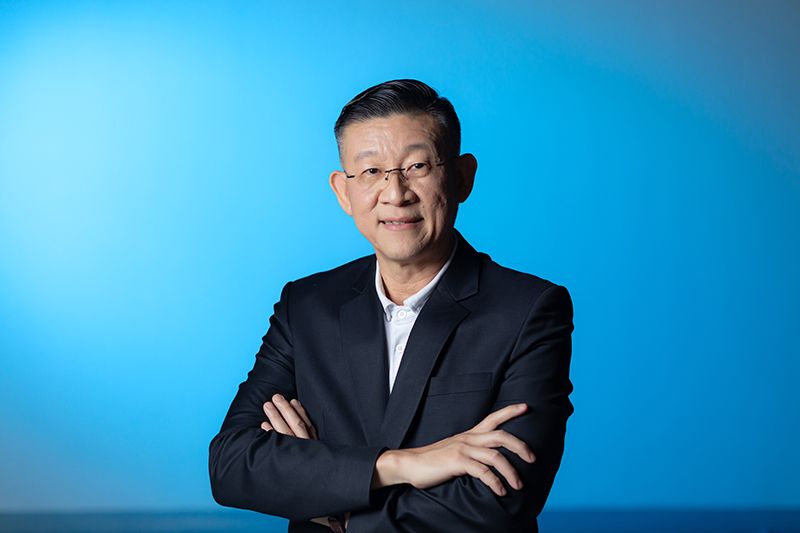
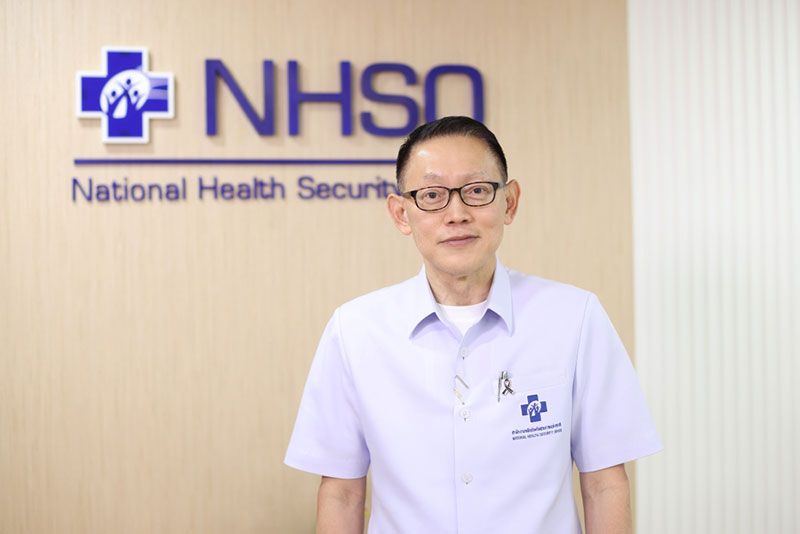
The resources mobilized through these three schemes are not only to finance healthcare, but also to strengthen the wider economy, said Dr. Jadej Thammatacharee, Secretary-General of the National Health Security Office (NHSO), which manages the UCS.
“UHC makes patients and members of the public feel that they do not have to keep accumulating money or worry about how much money they need to save for medical treatment when they become ill,” he said.
“Once this concern disappears, the money that previously had to be kept in reserve for healthcare when they became sick can instead be spent on everyday consumption. This systematic increase in consumption is itself a factor that drives overall economic growth.”
This reflects an important economic dimension of UHC. When households are protected from potentially catastrophic healthcare costs, they need less precautionary savings against illness. The resources that would otherwise be reserved for medical expenses can instead circulate through the wider economy.
A World Bank study similarly indicates that health security systems can stimulate economic activity. Thailand’s experience suggests that this effect can extend beyond household consumption to the way governments purchase medicines, medical supplies and services.
Turning health expenditure into domestic economic activity
One of the largest opportunities lies in pharmaceutical and medical-supply procurement.
When the NHSO examined health expenditure, it found that approximately half of the service budget is spent on medicines and non-drug medical supplies. Meanwhile, data from Thailand’s Food and Drug Administration show that the total value of medicines in the country reached 270 billion baht in 2023.
Of this amount, approximately 180 billion baht came from imports, while domestic production accounted for only 72 billion baht. The figures illustrate both the scale of the health system’s purchasing power and the economic opportunity associated with domestic production.
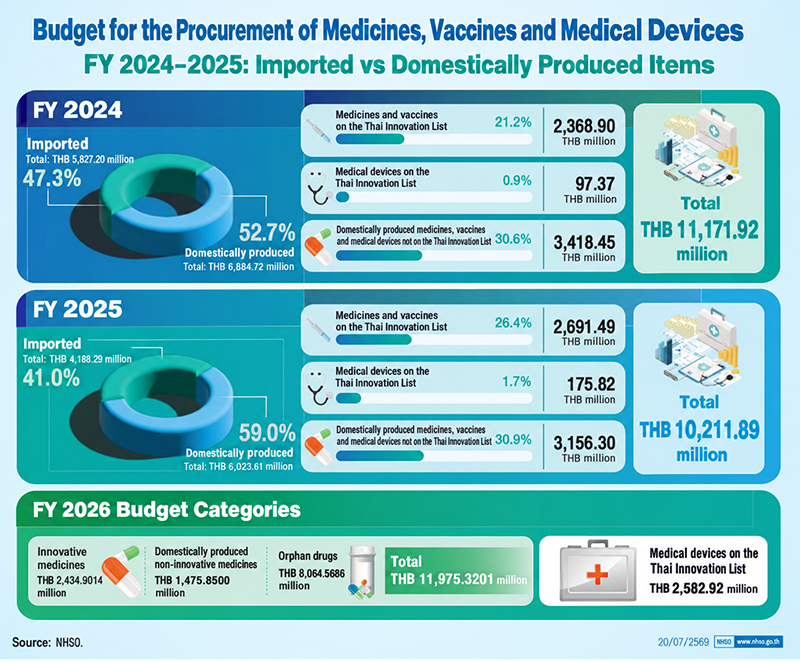
The NHSO currently manages approximately 11 billion baht per year in pooled medicine procurement through Rajavithi Hospital and the Government Pharmaceutical Organization. This represents around 20%, or approximately 2.4 billion baht, of the more than 100 billion baht spent on medicine procurement nationwide.
Therefore, public health procurement is not simply an expenditure line. It represents significant purchasing power that can potentially be used to strengthen domestic manufacturing capacity.
The NHSO argues that if government agencies and the Ministry of Public Health coordinate their procurement policies and increase purchases of medicines on Thailand’s innovation list and domestically manufactured medicines to 20–30%, the resulting market could be worth approximately 30–40 billion baht.
Such a shift could create demand for domestic pharmaceutical manufacturers, generate employment and increase the circulation of money within the Thai economy.
Using public purchasing power to attract investment
Thailand’s experience also demonstrates how predictable public-sector demand can become an incentive for multinational companies to invest locally.
One example is dialysis solution. The NHSO is a major purchaser, accounting for approximately 75% of the national market, with procurement worth around 3 billion baht annually. The scale and predictability of this demand can make domestic production commercially attractive.
Companies including Baxter, which established a manufacturing base in Rayong Province, and Fresenius, which established operations in Ayutthaya Province, illustrate how health-sector demand can be linked to investment in domestic manufacturing.
The same principle applies to vaccines, said Dr Jadej. The NHSO has clear annual procurement requirements for influenza vaccines, reaching approximately 7 million doses per year.
This creates a potential feedback loop: a large publicly financed health program generates predictable demand; predictable demand can encourage companies to establish production capacity in the country; domestic production can create jobs and investment; and greater domestic production can reduce reliance on imports.
Dr. Jadej described the purchasing power of UHC as a form of “commercial advantage” for Thailand.
He points to previous negotiations with AstraZeneca, which had plans to invest more than 6.2 billion baht to establish a plant producing diabetes medicines and new-generation cancer medicines in Thailand, as well as cooperation with South Korea on vaccine procurement.
Building a new economy around long-term care
Thailand is also exploring another economic opportunity emerging directly from demographic change: the growth of long-term care.
As Thailand moves into a fully ageing society, demand for care services is expected to increase. At present, approximately 500,000 homebound and bedridden older people receive care at home, supported by around 80,000 caregivers.
Under a government program for public health services for people with dependency, 12,500 caregivers were included in the economic stimulus policy for 2025. The program is expected to continue expanding to provide broader coverage as the population ages.
For the NHSO, however, long-term care is not only a social protection issue. It can also become part of a “New Economy” based on care services.
Thailand already has an internationally recognized hospitality and service sector. The policy proposition is to build on these capabilities by developing professionally trained and certified caregivers who can serve both the domestic population and international older people seeking long-term stays in Thailand.
Potential demand exists among foreign retirees with relatively high purchasing power. Dr. Jadej points to Scandinavian countries, where average pensions can reach 50,000–100,000 baht per month, and whose citizens may choose to spend extended periods in Thailand’s tourist destinations.
If Thailand can develop a high-quality, certified caregiving workforce, some of this international spending could flow directly into local communities through caregiver wages.
“This money would be converted into wages paid directly to caregivers working in grassroots communities, allowing people who previously had low incomes to move toward having stable incomes,” said Dr Jadej.
In addition, the NHSO currently supports the direct transfer of caregiver compensation into individual workers’ accounts, working with local authorities such as subdistrict administrative organizations and municipalities to assess their work..
According to Dr. Jadej, the system incorporates strict and transparent oversight mechanisms and has received certification from Thailand’s National Anti-Corruption Commission.
Such mechanisms matter because using public health spending to achieve wider economic objectives requires public confidence in how resources are allocated, said Dr. Jadej.
/////////