



Thailand is using the purchasing power of its Universal Health Coverage (UHC) to create demand for locally developed medical technologies—initiating a model seeking to link health financing, innovation and economic development.
For many countries pursuing UHC, the central challenge is how to finance and deliver essential healthcare to the population. Thailand is exploring another dimension of that challenge: how a national health purchaser can use its purchasing power to strengthen the country’s domestic health industry at the same time.
The National Health Security Office (NHSO), which manages the country’s Universal Coverage Scheme (UCS) --- a tax-funded healthcare scheme that covers 47 million people as part of Thailand’s UHC--- is increasingly positioning itself not only as a health-care payer but also as a “Big Buyer” of medical products and technologies developed in Thailand.
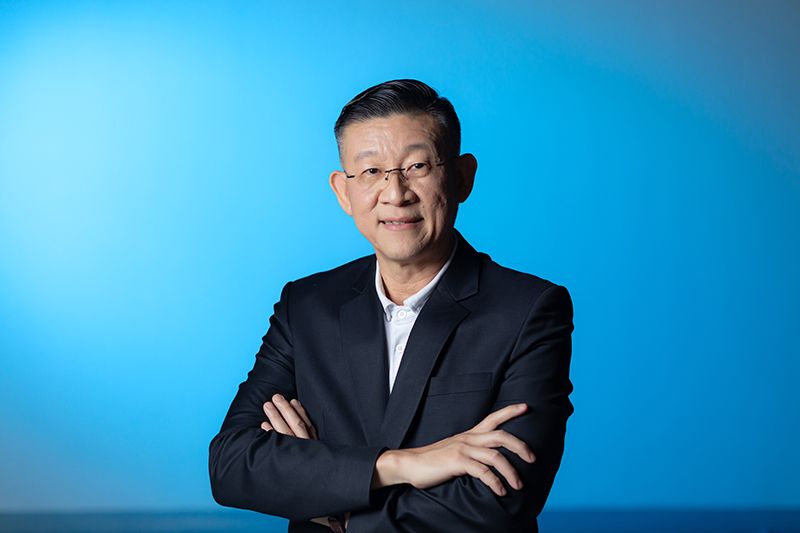
Dr. Atthaporn Limpanyalert, Deputy Secretary-General of the NHSO, said this approach seeks to reduce dependence on imported medical products while creating a predictable market for Thai companies and researchers. It is part of a broader shift by the NHSO from viewing health financing primarily as reimbursement for services toward what it describes as “strategic investment to build the foundation of the Thai economy.”
Thailand imports medical devices and equipment worth around 16 billion baht a year. For a national health system with significant purchasing power, the NHSO sees an opportunity to redirect part of this demand toward products developed domestically.
The NHSO already reimburses healthcare facilities under the UCS through a capitation-based budget covering outpatient and inpatient services. However, some medical devices, equipment and medicines have specific characteristics or requirements that make them less suited to standard reimbursement mechanisms.
This has prompted the NHSO to develop dedicated mechanisms for products included in Thailand’s Thai Innovation List, which identifies innovative products developed by Thai businesses and researchers.
The objective is not simply to substitute imports. By creating demand within the public health system, the NHSO aims to give Thai innovators a clearer pathway from research and development to commercial production and eventually large-scale use.
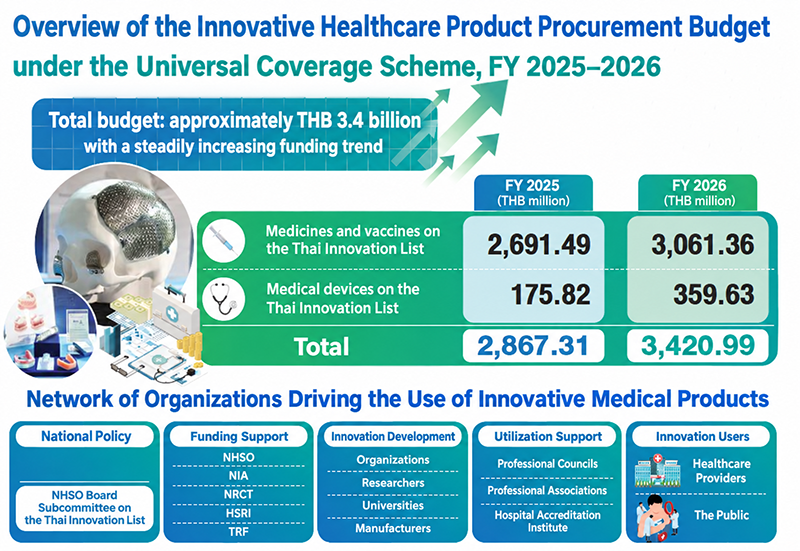
In the fiscal year 2026, products in the Thai Innovation list have received more than 3.4 billion baht in disbursements.
The NHSO is also working with institutions across Thailand’s research and innovation ecosystem, including the National Innovation Agency, the Food and Drug Administration, the National Science and Technology Development Agency, the Thailand Science Research and Innovation and the National Research Council of Thailand.
The aim is to identify promising research, support its commercial development and create a route for suitable innovations into the national health security system.
Creating a predictable market
One of the most significant elements of the NHSO’s approach is the use of procurement policy to create predictable demand.
General procurement rules require government agencies to purchase products in the Thai Innovation list at a minimum level of 30% of the procurement budget for each procurement.
The NHSO executive board, however, has resolved that medical products relevant to the NHSO system and included in the Thai Innovation Catalogue should be procured at 100%, using the applicable specific procurement mechanism.
For startups and smaller companies, access to a large public purchaser can be particularly important. Developing a medical technology requires significant investment in research, regulatory approval, manufacturing capacity and market development. Without sufficient demand, even technically successful products can struggle to move beyond the innovation stage.
The NHSO’s approach attempts to address that gap by connecting innovation policy directly to health-system demand.
According to Dr. Atthaporn, many medical devices and pieces of medical equipment in the Thai Innovation list have already been included as benefits under the UCS.
They include dental implants for supporting full-mouth dentures; ostomy bags and wafers; elastic band ligation kits for esophageal varices; dynamic prosthetic feet; titanium cranial plates; AI-assisted chest X-ray interpretation services; and urine-based screening kits for liver fluke infection.
Medicines in the list include linezolid, deferasirox, human coagulation factor VIII, intravenous immunoglobulin (IVIG), sofosbuvir and velpatasvir, dolutegravir, acellular pertussis vaccine (aP vaccine), darunavir, the combination regimen of dolutegravir, lamivudine and tenofovir disoproxil (TLD), and emtricitabine combined with tenofovir alafenamide (TAF-EM).
Building an ecosystem around health-system needs
The strategy is also expanding beyond physical medical products. The NHSO is seeking to support “Service Innovation”, including the use of artificial intelligence to improve disease screening and other healthcare processes, said Dr Attaporn.
The agency is opening opportunities for startups and technology companies to collaborate on AI applications for screening breast cancer and liver cancer, as well as systems for interpreting X-rays of bone fractures.
The intention is to prepare promising technologies for inclusion in the Thai Innovation List and eventually expand their use through the UCS.
As a “Big Buyer,” the NHSO can communicate the health system’s needs directly to manufacturers and researchers, allowing research and development to respond more closely to actual demand.
“The demand of the health system can be directly passed on to manufacturers and researchers,” Dr. Atthaporn said, explaining that this can help ensure that investment in research and development has a market and that resulting innovations can be put to practical use for the public.
The approach is intended to create an ecosystem in which healthcare needs, research, manufacturing and public procurement reinforce one another.
A stronger domestic medical industry can create opportunities for Thai businesses, strengthen technological capacity and support longer-term economic development while contributing to healthcare delivery.