



The National Health Security Office (NHSO) is strengthening the digital infrastructure of the Universal Coverage Scheme (UCS) by connecting the government’s ThaiD digital identity system to healthcare services, aiming to make beneficiary verification more secure while reducing administrative barriers to care.
The move represents the ongoing development of the UCS, commonly known as the “30-baht healthcare scheme,” which has evolved from a facility-based and paper-based entitlement system into a more digitally enabled platform for accessing and managing public healthcare.
The UCS provides healthcare coverage to more than 47 million people, while its health promotion and disease prevention services cover all 67 million Thai citizens. The NHSO plays a role as the scheme fund manager, which improves health benefits and proceeds with reimbursement.
As access to services increasingly extends beyond traditional healthcare facilities and into digital channels, the NHSO sees that reliable identity verification has become increasingly important.
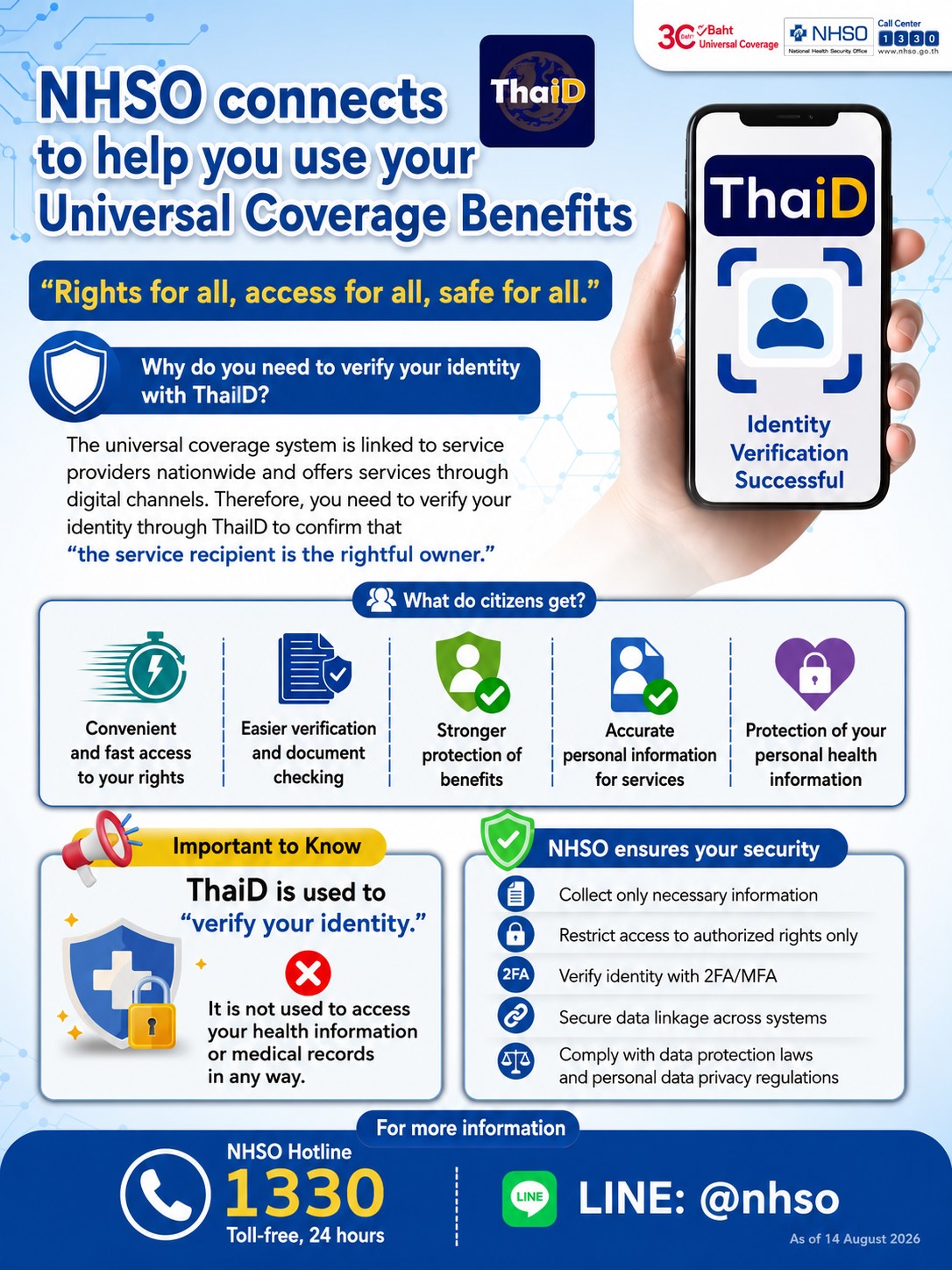
The connection with ThaiD, a digital identity application operated by the Department of Provincial Administration under the Ministry of Interior, allows healthcare providers to verify that a person seeking care is the rightful beneficiary.
The system is intended to reduce reliance on manual document checks and prevent the misuse of another person’s healthcare entitlement.
“The key issue is protecting people’s rights. We need to ensure that the person receiving a service is the rightful beneficiary. If identity verification is not sufficiently robust, it could lead to identity fraud, inaccurate information or unauthorized access to health records. ThaiD therefore helps ensure that people receive services under their own entitlements more accurately and securely,” said Pratuang Phaodit, Assistant Secretary-General of the NHSO.
He added that ThaiD can reduce the need for people to present multiple documents and allow healthcare providers to verify beneficiaries more quickly, particularly when people seek care outside their registered area or use digital services.
Accurate verification also helps ensure that healthcare records are linked to the correct individual and that claims made under the UCS fund correspond to actual services provided. This is intended to strengthen the transparency and accountability of public health financing.
The UCS, introduced in 2002, was designed to provide healthcare to people who were not covered by other public insurance schemes, particularly civil servants and social security schemes. It helped establish universal access to a comprehensive package of publicly financed healthcare services, with the NHSO acting as the purchaser and administrator.
The NHSO is also strengthening the wider security architecture supporting its digital systems. Measures include two-factor or multi-factor authentication, restricting access to only necessary information, reviewing user accounts and deactivating accounts or systems that are no longer in use.
For connections through application programming interfaces (APIs), healthcare providers’ information systems and relevant agencies must register and obtain authorization. Dedicated keys or tokens are used to control connections and help identify users and define the scope of their access.
The approach reflects a broader challenge facing health systems as they digitalize: expanding convenient access while ensuring that sensitive personal and health information remains protected.
Pratuang said this approach is consistent with recommendations from Thailand’s Personal Data Protection Committee and includes oversight by Data Protection Officers to ensure compliance with relevant laws and standards.
“The NHSO wants people to be confident that using ThaiD to verify their identity when accessing healthcare services is intended to ensure that everyone receives the services to which they are entitled, reduce the risk of identity fraud, protect health information and make accessing healthcare more convenient. The NHSO will continue developing the system while maintaining strong security and putting the interests of the public first,” he added.
///////////////////////////////